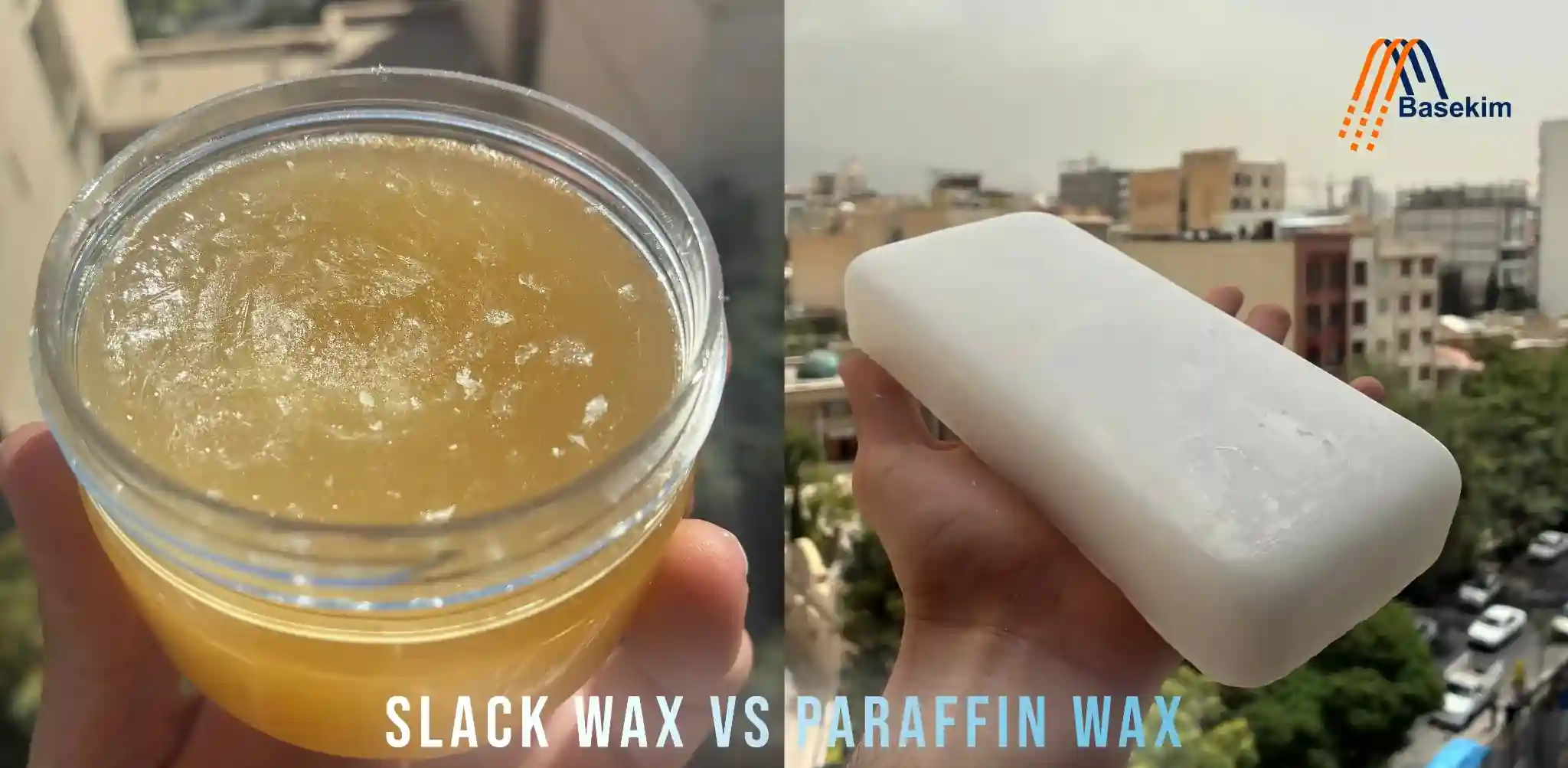
When choosing the right wax for industrial applications, many buyers compare slack wax vs paraffin wax. Although both materials come from petroleum refining, they differ in composition, oil content, performance, and end-use suitability. Therefore, understanding these differences helps manufacturers, traders, and purchasing managers select the most cost-effective option.
Moreover, choosing the wrong wax can affect product quality, processing efficiency, and overall production costs. For this reason, businesses often evaluate factors such as oil content, melting point, flexibility, and application requirements before making a purchase decision.
In this guide, we will explore the major differences between slack wax and paraffin wax, their advantages, industrial applications, and the factors that influence purchasing decisions.
What Is the Main Difference Between Slack Wax and Paraffin Wax?
The primary difference lies in the amount of oil present in each wax.
Slack wax contains a relatively high percentage of oil because it is an intermediate product produced during the refining process. In contrast, paraffin wax undergoes additional refining steps that remove most of the oil content.
As a result:
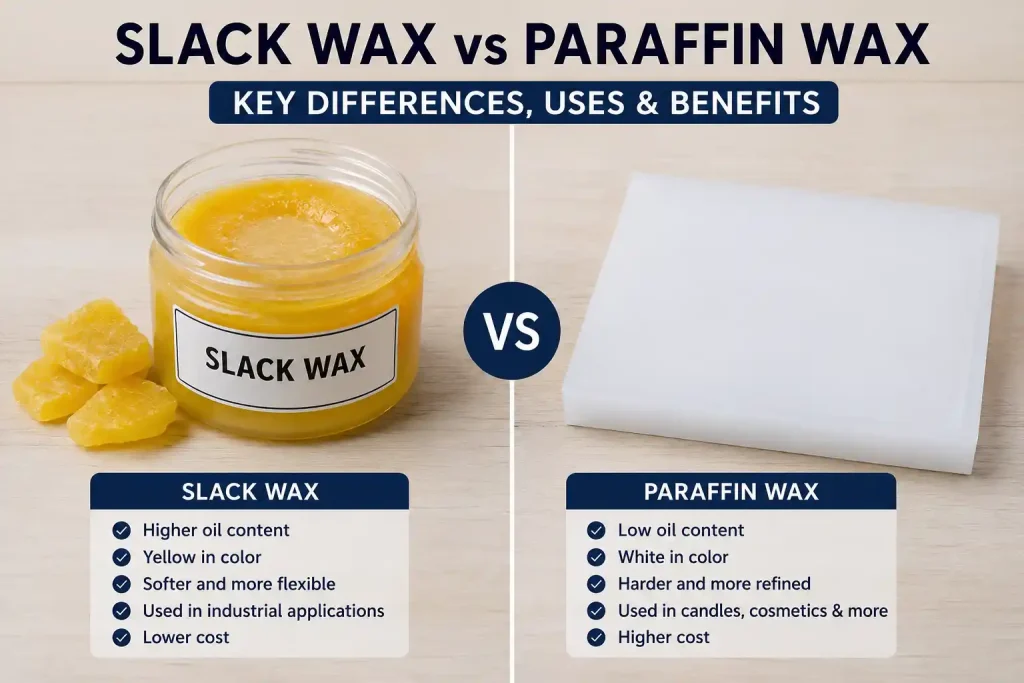
- Slack wax is softer and more flexible.
- Paraffin wax is cleaner and more refined.
- Slack wax costs less in many markets.
- Paraffin wax offers better consistency and appearance.
Therefore, the choice depends on the intended application rather than which wax is inherently better.
Slack Wax vs Paraffin Wax: Comparison Table
| Feature | Slack Wax | Paraffin Wax |
|---|---|---|
| Oil Content | Higher | Lower |
| Refinement Level | Semi-refined | Highly refined |
| Appearance | Darker or less transparent | Cleaner and brighter |
| Texture | Softer | Harder |
| Cost | Generally lower | Usually higher |
| Flexibility | Higher | Moderate |
| Purity | Lower | Higher |
| Industrial Use | Raw material and industrial products | Finished consumer and industrial products |
This comparison provides a quick overview. However, understanding how these differences affect performance is even more important.
Composition Differences
One of the most important aspects when comparing slack wax and paraffin wax is composition.
Slack wax contains:
- Wax hydrocarbons
- Residual oil
- Various petroleum fractions
Meanwhile, paraffin wax contains:
- Highly purified hydrocarbons
- Minimal oil content
- Fewer impurities
Because paraffin wax undergoes further processing, it delivers a more uniform structure. Consequently, manufacturers that require consistency often prefer paraffin wax.
On the other hand, companies that plan to process or blend wax further frequently choose slack wax as a raw material.
Production Process Comparison
The production method creates the biggest distinction between these two waxes.
Slack Wax Production
Slack wax emerges during the dewaxing stage of lubricating oil production. At this stage, wax crystals are separated from oil. However, the resulting product still contains a significant amount of oil.
Therefore, slack wax serves as an intermediate material rather than a final refined product.
Paraffin Wax Production
Manufacturers refine slack wax further through deoiling and purification processes. These additional steps reduce oil content and improve purity.
As a result, paraffin wax achieves:
- Better color
- Improved stability
- Consistent melting behavior
- Enhanced performance in finished products
Consequently, paraffin wax becomes suitable for applications that require higher quality standards.
Physical Properties Comparison
Physical properties often determine whether slack wax or paraffin wax is the better choice.
Hardness
Paraffin wax is generally harder because it contains less oil.
Meanwhile, slack wax remains softer and more pliable due to its higher oil content.
Flexibility
Slack wax provides greater flexibility. Therefore, it performs well in applications where cracking or brittleness must be avoided.
Conversely, paraffin wax offers more rigidity and shape retention.
Appearance
Paraffin wax typically appears lighter and cleaner.
Slack wax often has a darker appearance because of residual oil and impurities.
Melting Characteristics
Paraffin wax usually exhibits more predictable melting behavior. Consequently, manufacturers can achieve greater consistency during production.
Industrial Applications of Slack Wax
Many industries use slack wax because of its affordability and versatility.
Particle Board Manufacturing
Slack wax helps improve moisture resistance in wood-based panels. As a result, manufacturers can enhance product durability.
Rubber Industry
The rubber sector uses slack wax to protect rubber products from environmental degradation. Furthermore, it contributes to improved performance and longer service life.
Match Industry
Manufacturers use slack wax in match production because it offers suitable burning characteristics and cost efficiency.
Waterproofing Applications
Slack wax works effectively in waterproofing compounds. Therefore, it remains popular in construction-related industries.
Chemical Processing
Many producers use slack wax as a feedstock for creating more refined wax products and specialty blends.
Because of these diverse uses, slack wax remains an important industrial material worldwide.
Industrial Applications of Paraffin Wax
Paraffin wax serves a broad range of industries that require higher purity and consistency.
Candle Manufacturing
One of the largest uses of paraffin wax is candle production. Its clean-burning characteristics and reliable melting behavior make it a preferred option.
Packaging Industry
Paraffin wax helps protect products from moisture and contamination. Therefore, it contributes to product preservation and shelf-life extension.
Cosmetics and Personal Care
Manufacturers incorporate paraffin wax into various formulations because of its stable and refined nature.
Hot Melt Adhesives
Paraffin wax improves processing characteristics and performance in adhesive systems.
Textile Industry
Textile manufacturers use paraffin wax to enhance fabric processing and finishing operations.
As a result, paraffin wax remains one of the most widely used industrial waxes globally.
Cost Comparison: Which Is More Economical?
Price often plays a major role when comparing slack wax vs paraffin wax.
Generally, slack wax costs less because it requires fewer refining steps. Therefore, manufacturers seeking economical raw materials frequently select slack wax.
However, paraffin wax may provide better value in applications that require:
- Higher purity
- Better appearance
- Consistent performance
- Reduced processing variability
Consequently, the cheapest option is not always the most cost-effective solution.
Businesses should evaluate both purchase price and performance requirements before making a decision.
Which Wax Offers Better Performance?
The answer depends entirely on the intended use.
Choose Slack Wax When:
- Cost efficiency is a priority.
- Further processing will occur.
- Flexibility is important.
- High purity is not essential.
Choose Paraffin Wax When:
- Product consistency matters.
- Appearance is important.
- Lower oil content is required.
- Higher purity standards must be met.
Therefore, performance should always be evaluated within the context of the final application.
Environmental and Storage Considerations
Both waxes require proper storage and handling.
For best results:
- Store in cool, dry locations.
- Avoid excessive heat exposure.
- Protect products from contamination.
- Follow recommended handling procedures.
Additionally, proper storage helps maintain product quality and reduces material losses.
Although both waxes are stable materials, environmental conditions can influence long-term performance.
Factors to Consider Before Buying
Before purchasing slack wax or paraffin wax, buyers should assess several important factors.
Oil Content
Oil content significantly affects hardness, flexibility, and processing behavior.
Melting Point
Different applications require specific melting ranges. Therefore, buyers should verify technical specifications carefully.
Purity Requirements
Some industries demand highly refined materials. In such cases, paraffin wax often becomes the preferred choice.
Budget
Cost considerations remain important. However, buyers should also evaluate performance benefits.
End-Use Application
The intended application should always guide the final decision.
By considering these factors, businesses can improve purchasing efficiency and reduce operational risks.
Slack Wax vs Paraffin Wax: Advantages and Limitations
Advantages of Slack Wax
- Lower cost
- Greater flexibility
- Useful industrial feedstock
- Suitable for further refining
Limitations of Slack Wax
- Higher oil content
- Less refined appearance
- Lower purity
Advantages of Paraffin Wax
- High purity
- Consistent performance
- Better appearance
- Predictable melting behavior
Limitations of Paraffin Wax
- Higher cost
- Less flexibility compared to slack wax
Therefore, neither wax is universally superior. Instead, each material delivers advantages for specific applications.
How to Choose the Right Wax for Your Business
Selecting between slack wax and paraffin wax becomes easier when buyers focus on operational requirements.
First, identify the product’s performance expectations.
Next, evaluate processing conditions and quality standards.
Then, compare costs against long-term production benefits.
Finally, work with an experienced supplier that understands your industry requirements and can provide consistent product quality.
For companies sourcing industrial waxes in global markets, reliable suppliers such as Scurea can help ensure consistent supply and technical support.
Final Thoughts
The comparison of slack wax vs paraffin wax ultimately comes down to composition, purity, performance, and application requirements.
Slack wax offers a cost-effective solution with higher flexibility and greater oil content. Therefore, it remains a popular choice for industrial processing, rubber manufacturing, waterproofing, and feedstock applications.
Meanwhile, paraffin wax provides higher purity, better appearance, and more consistent performance. As a result, it serves industries that require refined and dependable wax characteristics.
Rather than asking which wax is better, businesses should focus on which wax best aligns with their production goals. By understanding the differences in oil content, processing, cost, and performance, buyers can make informed decisions that improve product quality and operational efficiency.
FAQ: Slack Wax vs Paraffin Wax
What is the difference between slack wax and paraffin wax?
The main difference is oil content. Slack wax contains more oil and is less refined, while paraffin wax undergoes additional processing to achieve higher purity and lower oil content.
Is slack wax cheaper than paraffin wax?
Yes. In most markets, slack wax is less expensive because it requires fewer refining processes.
Can slack wax be converted into paraffin wax?
Yes. Manufacturers can further refine and deoil slack wax to produce paraffin wax.
Which wax is better for industrial applications?
Both waxes are suitable for industrial use. The best choice depends on the specific application, purity requirements, and performance expectations.
Why does paraffin wax cost more?
Paraffin wax costs more because it undergoes additional refining steps that improve purity, appearance, and consistency.
Which wax has a higher oil content?
Slack wax contains significantly more oil than paraffin wax.
Is paraffin wax more refined than slack wax?
Yes. Paraffin wax is a more refined product and generally offers higher purity.
What should buyers consider when choosing between slack wax and paraffin wax?
Buyers should evaluate oil content, melting point, purity requirements, budget, processing conditions, and final product performance needs.
Does oil content affect wax performance?
Yes. Oil content influences flexibility, hardness, appearance, and processing characteristics.
Which wax is better for further processing?
Slack wax is commonly used as a feedstock for additional refining and specialty wax production because of its composition and lower cost.