

Microcrystalline wax is a petroleum-derived wax that helps manufacturers improve flexibility, adhesion, moisture resistance, and surface protection in products that require more than a conventional wax can offer. Its fine crystalline structure gives it different performance characteristics from paraffin wax, particularly when a formulation needs better binding, greater flexibility, or resistance to cracking. Choosing the right grade requires more than checking its melting point: buyers should also evaluate needle penetration, oil content, viscosity, compatibility, and performance under actual operating conditions. For industrial buyers, these properties determine whether a particular grade can meet production requirements without compromising product quality or processing efficiency.
What Is Microcrystalline Wax?
Microcrystalline wax is a refined petroleum wax composed primarily of saturated hydrocarbons with relatively branched and cyclic molecular structures.Unlike Paraffin wax , which typically forms larger crystals, this material develops much smaller crystals that create a cohesive, flexible structure.
Manufacturers use this structure to improve the binding properties, toughness, and protective performance of wax-based formulations. Depending on its grade, microcrystalline wax can help prevent surface cracking, reduce moisture penetration, and improve the stability of products exposed to changing temperatures or mechanical stress.
However, not every grade delivers the same results. Refining methods and formulation characteristics influence hardness, flexibility, oil content, and thermal behavior. Buyers should therefore select a grade according to its intended application rather than relying on the product name alone.
Microcrystalline Wax Grades and Key Properties
Suppliers offer different grades to meet the requirements of industrial processing, rubber manufacturing, adhesives, coatings, and specialty formulations. Buyers should compare the following properties before placing an order.
Melting point: Indicates the temperature range in which the wax transitions from a solid toward a molten state. A suitable grade must remain stable during storage and perform correctly at the application’s operating temperature.
Needle penetration: Measures wax hardness under specified test conditions. Lower penetration values generally indicate a harder material, while higher values indicate a softer one.
Oil content: Influences flexibility, surface behavior, and compatibility with other formulation ingredients. The appropriate level depends on the finished product’s requirements.
Viscosity: Affects flow and handling when manufacturers heat and incorporate the wax into a formulation.
Color and purity: Matter when the application requires a particular appearance or defined quality standards.
Compatibility: Determines how effectively the wax works with polymers, elastomers, resins, oils, and other additives.
A useful purchasing approach involves matching these properties to the production process and requesting representative samples when performance remains uncertain.
Microcrystalline Wax Melting Point and Technical Specifications
The melting point plays an important role in grade selection, but it cannot predict overall performance on its own. Two grades with similar melting points may behave differently because their hardness, oil content, molecular composition, and viscosity differ.
Manufacturers should identify the required operating temperature, processing conditions, and expected service environment before selecting a product. They should also distinguish between a specified melting point and a melting range or another thermal measurement reported by the supplier.
For quality control, buyers should request a Microcrystalline Wax Technical Data Sheet (TDS). This document should identify the relevant properties, test methods, specification limits, and recommended handling conditions for the actual grade.
A Safety Data Sheet (SDS), also commonly called an MSDS, provides information about hazards, safe handling, storage, exposure controls, and emergency procedures. These documents serve different purposes: the TDS supports product evaluation, while the SDS supports workplace safety.
Before approving a shipment, purchasing teams should compare the supplied specifications with the agreed requirements and request a Certificate of Analysis when available.
Microcrystalline Wax Industrial Applications
Microcrystalline wax supports several industries because its cohesive structure and adjustable properties suit formulations that require flexibility, protection, or binding performance.
Rubber Manufacturing
Rubber producers may incorporate selected grades into formulations that require surface protection, controlled wax migration, or resistance to environmental exposure. In rubber compounds, the wax can help form a protective surface layer under suitable conditions.
Adhesives and Sealants
Manufacturers can use compatible grades to modify tack, flexibility, viscosity, and handling characteristics. The final effect depends on the adhesive chemistry and the proportions of wax and other ingredients.
Protective Coatings
Coating producers may use microcrystalline wax to support water resistance, surface protection, and resistance to handling-related damage. Formulators must test compatibility to avoid unwanted changes in appearance, adhesion, or coating performance.
Packaging and Moisture Protection
Selected grades can help improve moisture resistance in suitable wax-based packaging systems. The correct choice depends on the packaging structure, contact requirements, and applicable regulations.
Cosmetics and Specialty Formulations
Certain appropriately refined grades may serve as structuring agents or consistency modifiers in cosmetic and specialty products. Buyers must verify the grade’s suitability, purity, and regulatory documentation for the intended use rather than assuming every industrial grade qualifies.
Across these applications, manufacturers should test the wax in the complete formulation. A product that performs well in one system may not deliver the same results in another.
Microcrystalline Wax for Rubber: Selection Considerations
Rubber manufacturing requires careful attention to the relationship between wax migration, temperature, compound composition, and environmental exposure. In some rubber products, selected waxes migrate gradually toward the surface and create a protective barrier. This behavior can help reduce ozone-related surface degradation under suitable conditions.
However, excessive or insufficient migration may reduce the intended benefit. The wax must move through the rubber at an appropriate rate while remaining compatible with the compound’s other ingredients.
When evaluating microcrystalline wax for rubber, manufacturers should consider:
The type of rubber and the complete compound formulation.
The expected service temperature and environmental exposure.
The desired migration behavior and surface protection.
Compatibility with processing oils, fillers, and other additives.
The wax’s hardness, melting characteristics, and oil content.
Laboratory testing and accelerated aging assessments can help manufacturers evaluate the grade before introducing it into full-scale production. This approach reduces the risk of selecting a product based solely on a general-purpose specification.
Microcrystalline Wax vs Paraffin Wax
Microcrystalline wax and paraffin wax both originate from petroleum refining, but their molecular structures give them different physical characteristics.
| Property | Microcrystalline Wax | Paraffin Wax |
|---|---|---|
| Crystal structure | Smaller, finer crystals | Generally larger crystals |
| Typical texture | More cohesive and often flexible | Often harder or more brittle, depending on grade |
| Binding behavior | Often provides stronger cohesion | Depends on grade and formulation |
| Flexibility | Frequently offers greater flexibility | Varies with composition and grade |
| Common selection priorities | Adhesion, toughness, flexibility, and protection | Cost-effective wax applications and crystallization behavior |
| Industrial use | Rubber, adhesives, coatings, and specialty formulations | Candles, packaging, coatings, and other wax applications |
These differences are general rather than absolute. Individual grades can overlap in hardness, melting behavior, and performance.
Manufacturers should choose microcrystalline wax when the formulation benefits from its cohesive structure and particular mechanical properties. Paraffin wax may remain the more economical option when the application does not require those additional characteristics. Some formulations can also benefit from blending the two waxes to achieve a balance of cost, hardness, flexibility, and processing behavior.
Microcrystalline Wax Supplier, Manufacturer, and Distributor
Choosing a reliable Microcrystalline Wax Supplier involves evaluating product consistency, technical support, documentation, and delivery reliability—not simply comparing quotations.
A Microcrystalline Wax Manufacturer should provide clear grade specifications and appropriate quality documentation. Buyers working through a Microcrystalline Wax Distributor should also confirm product traceability, storage practices, packaging, and access to manufacturer documentation.
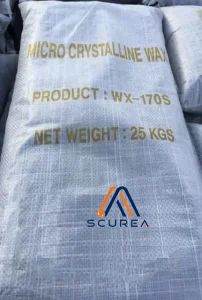
For manufacturers that consume wax regularly, the supplier should understand production requirements and help identify grades that match the intended formulation. Scurea can be considered as a sourcing contact for buyers evaluating industrial wax requirements; purchasers should confirm current availability, grade specifications, and supply terms directly before committing to an order.
Before selecting a supplier, purchasing teams should ask for:
A current TDS and SDS for the proposed grade.
A quotation specifying grade, quantity, packaging, and delivery terms.
Batch consistency and quality-control documentation.
Minimum order quantities and expected lead times.
Sample availability for laboratory testing.
Export documentation and shipping arrangements when required.
A clear purchasing specification helps reduce misunderstandings between the buyer, distributor, and manufacturer.
Microcrystalline Wax Price and Wholesale Purchasing
Microcrystalline Wax Price varies according to grade, refining quality, specifications, order volume, packaging, freight, and market conditions. Products with tighter technical requirements may cost more than standard industrial grades because they require specific properties or additional quality controls.
Buyers seeking Microcrystalline Wax Wholesale prices should compare quotations on an equivalent basis. A lower price does not necessarily represent better value if the grade fails to meet production requirements or creates processing difficulties.
For bulk purchasing, request quotations that specify:
The exact grade and required technical properties.
Order quantity and packaging format.
Delivery location and shipping terms.
Payment terms and quotation validity.
Required quality certificates and documentation.
Sample approval and procedures for handling nonconforming material.
A Microcrystalline Wax Bulk Supplier should also provide realistic lead times and explain how it manages repeat orders. Manufacturers can improve purchasing decisions by comparing the total delivered cost and expected production performance rather than focusing exclusively on the price per kilogram.
Choose the Right Microcrystalline Wax Grade
Selecting microcrystalline wax requires a clear understanding of the finished product, processing conditions, and required performance. By comparing technical specifications, testing compatibility, reviewing safety documentation, and evaluating total purchasing costs, manufacturers can make more informed sourcing decisions.
Before placing a bulk order, confirm the grade’s suitability through its technical documentation and, where necessary, laboratory testing. A well-defined specification and a dependable supply arrangement can help support consistent production quality and more predictable purchasing outcomes.